d e t e k t o r i n t e r n a t i o n a l · 1 3
Security News Every Day
www. securityworldhotel.com
Security News Every Day
www. securityworldhotel.com
domain, as before. Microsoft and
Genetec will ensure the techno-
logical functioning of the system."
How big are cloud servic-
es today? How big will it
become in the future?
Martin Andersen:
"Cloud services
are already very popular with ser-
vices targeting consumers, and it
continues to grow. Many security
companies have an agenda to
move away from having "feet on
the ground" and instead focus on
services that are enabled by tech-
nology. The future winners of the
security industry are those who
take full advantage of technology,
and in this scope, taking advan-
tage of cloud services."
Anders Geeber:
"Cloud services
are definitely here to stay when
it comes to video surveillance
and access control. However, I
am more uncertain about in-
truder alarms and fire alarms. The
technology allows for more than
regulations do and cloud services
for fire alarms will take longer to
break through since regulations
are stricter and there are not as
many managing the facilities.
In summary, cloud services will
grow."
Martyn Ryder:
"In Europe today
they are not as big as in other
geographical locations but there is
plenty of opportunity for growth.
How big it will become is hard
to say cloud computing may
become the norm. We will utilise
it where we feel best but will still
have elements where a locally
installed solution will be preferred,
but the balance may shift in
time it will really be depend on
whether the customer feels that
the cloud is safe and that it makes
economical sense."
Nick D'hoedt:
"Security in
the cloud is still small, but it is
already growing exponentially
and in the end, the cloud will
have no limit." n
cloud solutions are much bigger
than those that an independent
organisation could set out."
How will customers work
within the systems? For
example, who should add
permission/authorisation
for access control services
the end customer or the
provider?
Martin Andersen:
"This depends
on the service that is being of-
fered. An alarm company that is
deploying video verification may
not want the end customer to
use the video cameras for their
own use, and as such the end user
should not work in the system.
However, in other, perhaps more
attractive solutions, the end user
can use the video system in his
everyday life e.g. in a retail
store to investigate theft or fraud.
For access control the service
provider can sell both a "managed
by" solution and a "manage it
yourself" solution depending on
the customer needs and willing-
ness to pay."
Anders Geeber:
"It is up to the
customer to choose. He or she can
let us take responsibility and we
will set up a routine for how to
manage it and then we do the job.
Then there are customers who are
happy to pay for a service but will
perform part of the administration
or service themselves, for example
through a web interface."
Martyn Ryder:
"This really
depends on our customer's needs.
The beauty of the cloud is that it
becomes a hybrid model, either
our customer manages the solu-
tions or we can do this for them
they can start off managing it
themselves and in time we could
take over this service with no
new investments in hardware or
software, companies can adapt to
changing business needs."
Nick D'hoedt:
"The customer
remains responsible for their own
services should be sold on the
basis of being a "cloud service".
Cloud in itself does not provide
any significant benefit to the end
customer it is how the service
provider builds services based on
the cloud technology."
Anders Geeber:
"It is very dif-
ficult to say exactly how safe it
is. We are facing the exact same
problem as other industries when
it comes to dealing with secure
logins, redundancies, access
resources, and so on. Add to this
that we often open up a con-
nection from ourselves to the
customer's network. The most
demanding dialogue in this type
of business is the choice of security
solutions, which often is made
together with our customers."
Martyn Ryder:
"The easiest
way to understand is to liken it
to internet banking we have
increasingly less need to go to
the local bank branch to carry
out transactions, we just hop on
a computer, go through security
clearance and do what we need
to do. There is an argument that
cloud services can be safer than
onsite installations for example
if someone broke into your busi-
ness and stole a recording device
they have all your video. In the
cloud we take away these threats
as it is locked away in enterprise
data centres."
Nick D'hoedt:
"The knowledge
level and infrastructure size for
rarely discussed. The customer is
bound to the supplier and this can
often be an unforeseen risk."
Martyn Ryder:
"With CCTV
the disadvantages still sit with the
amount of data being sent and
stored there are associated costs
for this such as internet charges
and also bandwidth limitations
which makes it difficult today to
deploy high camera counts. The
other disadvantage is if connection
is lost e.g. internet failure, then up
to date information is not there at
your fingertips, but solutions are
in place to make sure once back
on line everything is brought up
to date."
Nick D'hoedt:
"As far as we see
it, we have a security risk level
that will be the lowest. Who
could better secure and run the
Microsoft Azur environment
than Microsoft, and who could
best maintain their own solution
than Genetec. Even the European
commission is blue stamping the
Microsoft Azur. In the US, banks
and even complete cities are
trusting the combined network
and its embedded solution."
How safe are cloud
services and how will
customers be able to
understand how safe
they are?
Martin Andersen:
"One key
question is, whether these security
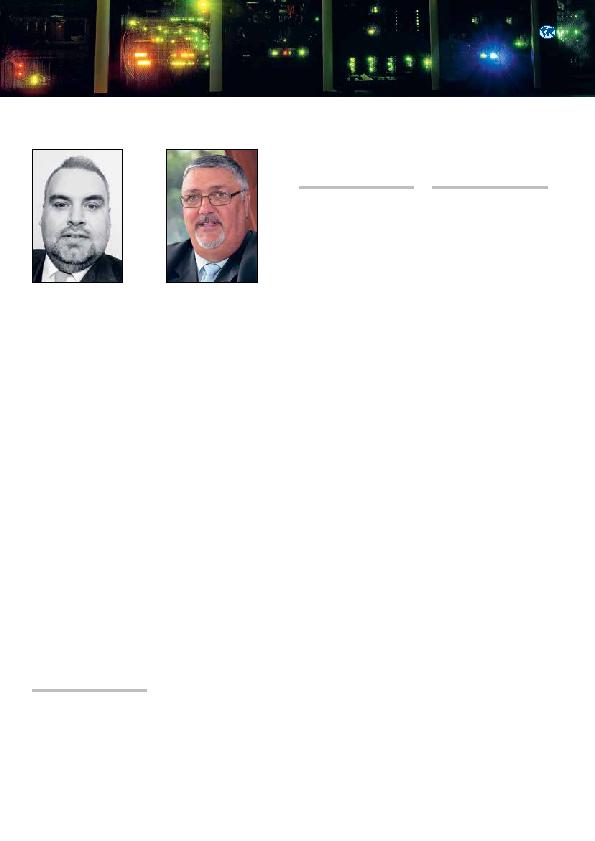
Nick D'hoedt, Regional Sales Director
for Benelux, DACH & Nordics at
Genetec.
Martyn Ryder, Director of Product
Management at Stanley Security
Solutions.
security technology market
What are the major advantages of cloud security services?